
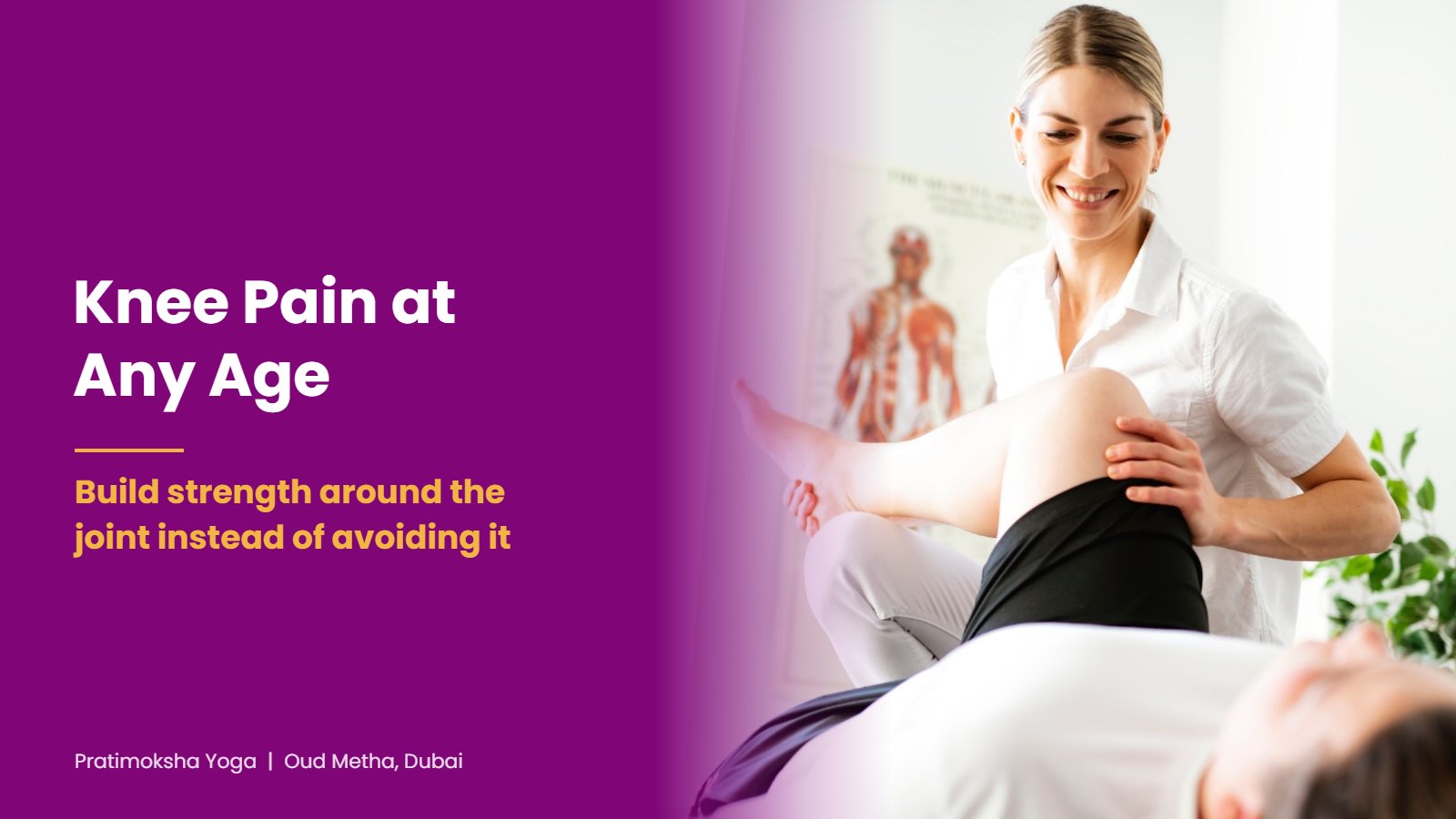
Strength around the knee is the most dependable thing a person with knee pain can build, at almost any age, and yoga turns out to be a serious way to build it. In a trial published in JAMA Network Open in 2025, researchers at the Menzies Institute for Medical Research, University of Tasmania, randomly assigned 117 adults over 40 with knee osteoarthritis to either a yoga program or a strengthening exercise program for 12 weeks. Knee pain fell substantially in both groups, and yoga met the trial’s test for being no less effective than the strengthening program.
The longer view was more interesting. By 24 weeks, when people were practicing at home without supervision, the yoga group showed greater improvement in pain, stiffness and day-to-day function on a standard arthritis questionnaire. Practice that people keep doing on their own is practice that works, and I think that is the part of the result worth noticing.
Local data is thinner than it should be. A 2024 scoping review in the Middle East Journal of Rehabilitation and Health Studies found only a handful of studies on knee osteoarthritis in the UAE, reporting rates from 1.4 percent in one Dubai insurance dataset of people aged 45 to 54 to 25.8 percent among Emiratis attending Dubai primary care clinics. The reviewers linked higher body weight to the condition and called for better research. What the figures do show is that knee pain here is common enough to deserve a plan rather than a shrug.
Why rest feels right and backfires
When a knee hurts, protecting it feels sensible. People skip the stairs, give up the evening walk along the Creek, and stop bending the knee further than they must. The trouble is what happens next. The quadriceps, the large muscles at the front of the thigh that steady the kneecap and absorb load, weaken quickly when they stop working. A weaker thigh hands more of every step to the joint itself, and the knee starts to hurt on less.
Cartilage has its own reason to want movement. It has no blood supply of its own and takes its nourishment from the joint fluid, which moves in and out as the joint is loaded and released. A knee that hardly moves is a knee whose cartilage is being fed less.
Dubai’s long summers add a quieter version of the same problem. Months of walking from an air-conditioned car to an air-conditioned lobby can take away the daily steps and stairs that kept a knee strong, without anyone deciding to rest it. Weight plays its part too: every kilogram lost takes a multiple of that weight off the knee with each step, which is one reason the UAE reviewers’ link with body weight deserves attention.
None of this means pushing through sharp pain. It means finding the amount of movement the knee can take today, and building from there.
The same complaint, three different knees
Knee pain at 25 and knee pain at 70 share a name and very little else. The approach changes with the person:
- In younger adults, pain around or behind the kneecap tends to follow running, football or a sudden jump in training, and the work goes into the hips and thighs that control how the knee tracks
- In the middle years, a desk-heavy week, extra weight and weekend sport tend to meet, and early wear begins to show; strength and alignment matter most here, before the joint changes much
- In older adults, osteoarthritis, stiffness on waking and a less certain balance come together, and the goal is strength that makes stairs, getting out of a chair and walking without fear possible again
The common thread is that the knee sits between the hip and the foot, and it tends to be the joint that pays for problems in either.
How a yoga therapy session works with a knee
Lalitha Viswanath is a manual osteopath who has taught classical yoga in Dubai for more than 20 years, and the studio’s knee work starts the way an osteopath would: with how the person stands, walks and climbs onto a step. Flat feet, a hip that drops on one side, or a knee that drifts inward as it bends all change what comes next.
Then comes the building. Supported chair pose with the back against a wall, with the depth set by comfort rather than ambition. Bridge pose to wake up the back of the thighs and the buttocks. Warrior poses with the knee tracking over the second toe. Standing balances with a hand on the wall. A block between the thighs, a chair for support or a folded blanket under the knee lets each of these meet the knee where it is.
Between sessions, a short home sequence of three or four of these poses, done most days, carries the work forward. In the Tasmanian trial, the yoga group’s best results came during the months people practiced at home.
Some things wait. Deep kneeling in vajrasana, full lotus and quick twists under load are left out at first, sometimes for months. A mild ache that settles within a day is acceptable. Sharp pain, swelling or a knee that gives way means stopping and, where needed, seeing a doctor. Pratimoksha’s musculoskeletal yoga therapy is built to work alongside medical care rather than replace it.
Patience is part of the treatment
Muscle responds in weeks and tendons in months, and the classical texts were never in a hurry either. The yogic idea of tapas, steady effort that keeps its heat without burning out, describes knee rehabilitation better than most clinical leaflets. Responsibility over quick relief is the honest version of the promise: the practice works when the person keeps showing up, and the studio’s job is to make showing up safe. Progress shows first in small things: standing up from a low sofa without a hand, or taking the metro station stairs without thinking about it.
That is also why a knee program designed for one person tends to outlast a general class. The individual program shapes the sequence around one set of knees, one history and one schedule.
People with a sore knee in Oud Metha, Karama or Bur Dubai can also come in for the free one-on-one Yoga Body Check from 11 to 14 November, which includes a structural look at how the legs and hips are moving. To book that, or to ask about a knee that has been bothering you for a while, contact the studio and describe what the knee is doing. The first conversation is usually where the plan starts.


0 Comments