
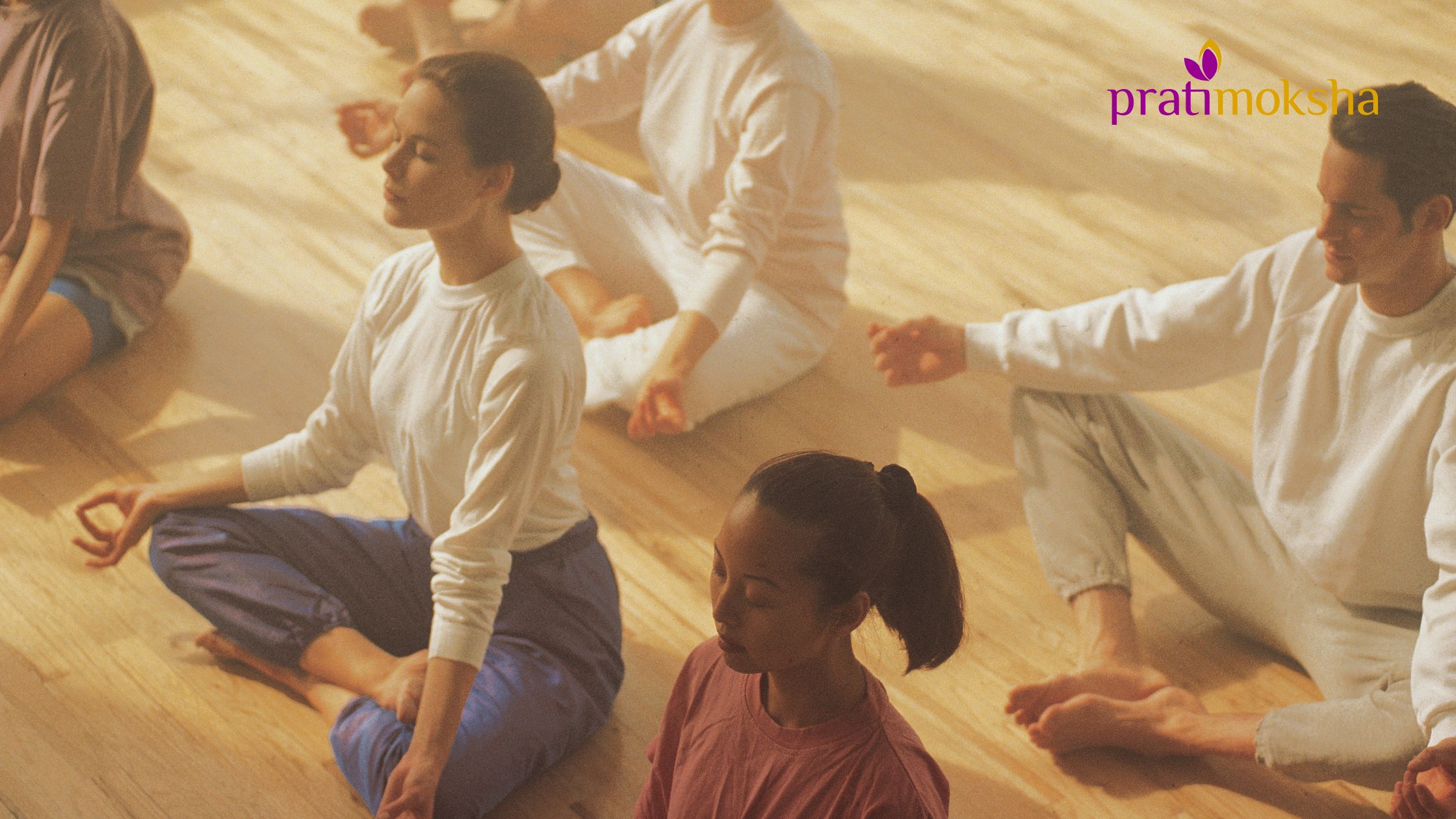
Most studios that offer “advanced” classes just make the postures harder. Same one-hour format, same group setting, more difficult variations. Pratimoksha’s Signature Program was built on a different premise entirely: depth isn’t about difficulty, it’s about sequencing.
A recent scaffolded skills study in pharmacy education found that when training was broken into deliberate, sequential stages rather than delivered all at once, student confidence improved significantly across nearly every measured domain, with some gains large enough to be educationally meaningful rather than marginal. The underlying idea isn’t new. Vygotsky’s zone of proximal development, a concept education researchers still lean on heavily, holds that people learn best when new material sits just beyond what they can already do, supported by the right structure at the right moment. Yoga is no exception, even though very few programs are actually built around that principle.
The three tracks, and why they exist separately
The Signature Program is organized into three connected tracks rather than a single advanced class, because the three areas of practice develop different capacities and, frankly, at different speeds.
Asana & Beyond deepens physical practice past technique into awareness, using extended holds and stillness to build the kind of body-based attention that later work depends on. Prana & Beyond trains breath as its own discipline, moving through observation, ratio work, and eventually retention, each stage requiring the one before it to be genuinely stable. Dhyana meditation builds concentrated attention in the classical sense, something that becomes accessible only once the body can hold stillness and the breath has already been settled through prior training.
Treating these as one track would mean rushing whichever piece happens to be weakest. Treating them as three separate ones lets a student go deep in one area while staying at an earlier stage in another, which is closer to how real progress actually happens.
Why the order matters more than the content
It would be simpler to let students pick whichever track interests them and work through it in isolation. Some studios do exactly that. Pratimoksha doesn’t, because the sequencing between tracks isn’t cosmetic.
Breath control taught to a student who hasn’t developed physical stillness through asana work tends to produce shallow, effortful retention rather than the relaxed control the technique is meant to build. Meditation instruction given before breath has been settled usually results in a restless mind fighting stillness rather than resting into it. Lalitha Viswanath has built the program’s progression around this exact observation, developed over almost two decades of watching where students get stuck when the order is skipped.
This is also why the program resists shortcuts. A student eager to reach meditation quickly is sometimes asked to spend more time in breath work first, not because the studio wants to slow anyone down artificially, but because skipping ahead tends to create the very plateau the program exists to prevent.
How this plays out for a working professional in Dubai
Structure matters even more for students juggling demanding schedules, which describes a large share of Pratimoksha’s student base. Someone working long hours in Downtown Dubai or managing a team out of a Dubai Media City office doesn’t have unlimited time to experiment with an open-ended, self-directed practice. A structured sequence tells them exactly where to focus their limited hours, rather than leaving them to guess.
There’s also a psychological benefit specific to Dubai’s particular rhythm. The city moves fast, and most professional environments here reward visible, quick progress. A structured program with clear stages gives students something concrete to measure against, even while the underlying work is intentionally slow. Without that structure, many students would either rush the process or abandon it the first time results felt slower than expected, which is a familiar failure pattern across most self-directed wellness habits, not just yoga specifically.
What a typical progression looks like
There’s no single required path, but a common pattern has emerged over the years the program has run. Students usually begin in Asana & Beyond, spending anywhere from several months to a year building physical stillness and postural awareness beyond what a standard class covers. From there, many move into Prana & Beyond, working through the stages of breath control at whatever pace the technique demands. Dhyana meditation tends to come last, though a smaller number of students arrive at the studio already drawn to stillness and move through the earlier tracks more quickly to reach it.
None of this is enforced rigidly. A student with an already stable meditation practice from years of prior experience elsewhere might move through the sequence faster. Someone newer to structured practice generally benefits from taking each stage seriously rather than treating it as a formality to get past.
Why the structure outlasts any single class
Programs built for depth tend to be judged by their first few weeks, which is exactly the wrong timeframe to judge them by. The value of a sequenced structure like this one shows up later, in the difference between a student who quietly keeps building on stable ground and one who plateaus because a stage got skipped somewhere along the way.
That difference compounds. Two students who start on the same day, one moving through Asana & Beyond, Prana & Beyond, and Dhyana meditation in order, the other jumping between whichever felt most appealing that week, tend to look similar after a month and quite different after a year. Sequencing is the kind of decision whose cost or benefit is almost invisible in the short term and unmistakable in the long one.
Pratimoksha’s studio in Oud Metha runs all three tracks on a rolling basis, so a student ready to begin doesn’t have to wait for a new term to start. The Signature Program page outlines current class timings for each track, and a trial session remains the most direct way to see where the sequence would begin for you.


0 Comments