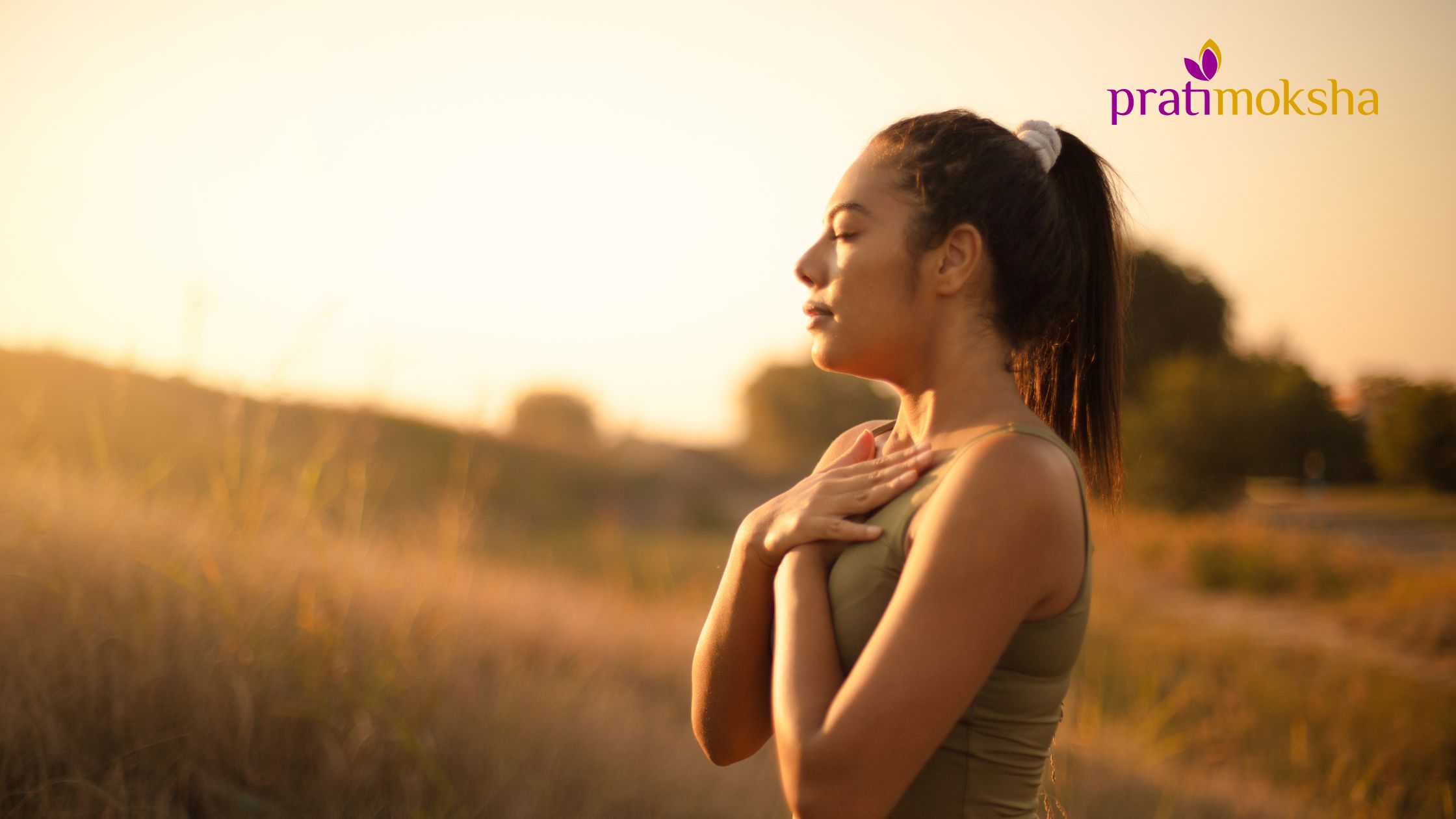
Most people who start pranayama are trying to breathe better. That’s not really the point, and treating it that way is usually where the practice stalls.
A 2024 study from the Department of Physiology at AIIMS Bhopal examined Bhastrika Pranayama in regular practitioners and found measurable shifts in heart rate variability and brain wave activity within a single session, evidence that the practice does something structural to the nervous system rather than simply calming a person down for a few minutes. A separate clinical study on alternate nostril breathing found that six weeks of regular practice meaningfully strengthened parasympathetic tone, the part of the nervous system responsible for rest and recovery. These aren’t small effects. They point to something closer to training than relaxation.
That distinction matters, because most people encounter pranayama through a five-minute add-on at the start or end of a yoga class. Three rounds of deep breathing, a brief pause, then on to the postures. There’s nothing wrong with that as an introduction. But it isn’t pranayama as a discipline, and conflating the two is why so many practitioners in Dubai assume they’ve already “done” breathwork when they’ve barely touched it.
Breath control is not the same as breathing exercises
The word pranayama breaks down into prana, meaning life force, and ayama, meaning extension or control. It was never framed as a wellness technique. In classical texts it sits alongside asana and dhyana as one of the eight limbs of yoga, a discrete discipline with its own progression, not a warm-up act for the postures.
A breathing exercise asks you to breathe differently for a few minutes. Pranayama as a discipline asks something larger: sustained attention, a specific ratio of inhale to exhale to retention, and a willingness to sit with the discomfort that shows up when breath is deliberately restrained. That discomfort is not incidental. It’s often where the actual work happens.
At Pratimoksha, this distinction shapes how the Prana & Beyond track is taught. Students don’t move through techniques quickly. They stay with one pattern long enough to notice what it does to the mind, not just the lungs.
Why the discipline requires structure
Unstructured breathwork, done without guidance, carries real limits. Some techniques increase sympathetic activation rather than reduce it, which is useful in specific contexts and counterproductive in others. Practicing the wrong pattern at the wrong time, or holding the breath longer than the body can handle without strain, can leave a person more anxious rather than less.
This is one reason Lalitha Viswanath insists on a graduated approach rather than teaching advanced retention techniques early. Her training emphasizes that pranayama, done carelessly, can do the opposite of what it promises. Done with structure and supervision, over months rather than days, it becomes one of the more reliable tools available for regulating a nervous system under constant low-grade pressure.
That pressure is familiar to a lot of people living and working in Dubai. Long commutes across the city, air conditioning running most of the year, and a professional culture that rarely slows down all add friction to something as basic as breathing well. Students who spend their days in Business Bay towers or DIFC offices often arrive already breathing shallow and fast, a pattern the body adapts to and then forgets is a pattern at all.
What a structured pranayama practice includes
The progression at Pratimoksha typically moves through distinct stages, each building on the last. Awareness work comes first, where students simply observe the natural breath without altering it, often the hardest stage for beginners. Ratio work follows, learning specific inhale-to-exhale timing before any retention is introduced. Retention comes next, holding the breath after inhalation or exhalation under close guidance. Nostril-specific techniques, including alternate nostril breathing, are used to balance the nervous system. Integration is the final stage, where breath control is layered with seated stillness and eventually meditation.
Skipping stages is common among self-taught practitioners, and it’s usually where problems start. A student attempting extended retention without first mastering ratio work is training the wrong thing entirely.
Where the discipline eventually leads
Pranayama practiced seriously tends to change a student’s relationship with asana, too. Postures that once felt like effort start to feel like extensions of the breath rather than separate exercises the breath happens to accompany. This is part of why Prana & Beyond sits within the studio’s broader signature program, rather than as a standalone technical class. The two are meant to inform each other.
For students who continue past this stage, breath work becomes the natural entry point into seated meditation, since a settled nervous system is what makes stillness possible in the first place. That progression is built directly into the studio’s dhyana meditation offering. Others find that breath work alone, practiced consistently through the regular yoga classes schedule, is exactly the depth they were looking for.
There is no universal endpoint. Some students spend years refining a handful of techniques. Others move through the stages quickly and find their attention pulled toward stillness instead. What tends to separate a real pranayama practice from an occasional breathing exercise isn’t ambition. It’s consistency, applied slowly, over a long enough stretch of time to actually change something.
Anyone curious what that progression feels like in practice is welcome to join a session and experience the first stage directly. A trial class at the Oud Metha studio is the most direct way to find out whether this kind of structured breath work belongs in your practice.



0 Comments