
Yoga hurts more people than its gentle reputation suggests, and the harm rarely comes from the poses that look dangerous. When researchers at the University of Sydney followed 354 practitioners for a year, about one in ten developed new musculoskeletal pain from their practice, and 21 percent of existing injuries got worse. Most of the new pain sat in the shoulders, elbows, wrists and hands, and the pose the team linked to it was downward dog, one of the first postures any beginner learns.
A separate study in the Orthopaedic Journal of Sports Medicine, from the University of Alabama at Birmingham, counted yoga injuries treated in US emergency departments between 2001 and 2014. The rate rose from 10 to 17 per 100,000 participants, and in 2014 it reached 58 per 100,000 among people over 65. Comparable figures for the UAE are not currently available. The people who walk into a studio in Dubai bring the same bodies, though: backs shaped by long hours at a desk, stiff hips, knees that have done years of stairs and treadmills.
None of this makes yoga unsafe. It says the risk lives in the gap between what a teacher sees and what the body underneath is doing. Closing that gap is the point of the two titles that sit beside Lalitha Viswanath’s name.
Two titles, two kinds of knowing
Manual osteopathy is a hands-on discipline. A manual osteopath assesses how joints, muscles and connective tissue move together, and treats the body as one connected structure rather than a set of separate parts. Much of the training is in palpation: feeling through the hands where movement stops, where tissue guards, and where one joint is doing the work another has given up.
Acharya is an older word. It is usually traced to the Sanskrit achara, conduct, and the traditional sense of an acharya is a teacher whose own conduct carries the teaching. A Yoga Acharya is expected to know the classical texts, the sequences and the breath, and to live the discipline closely enough to pass it on whole.
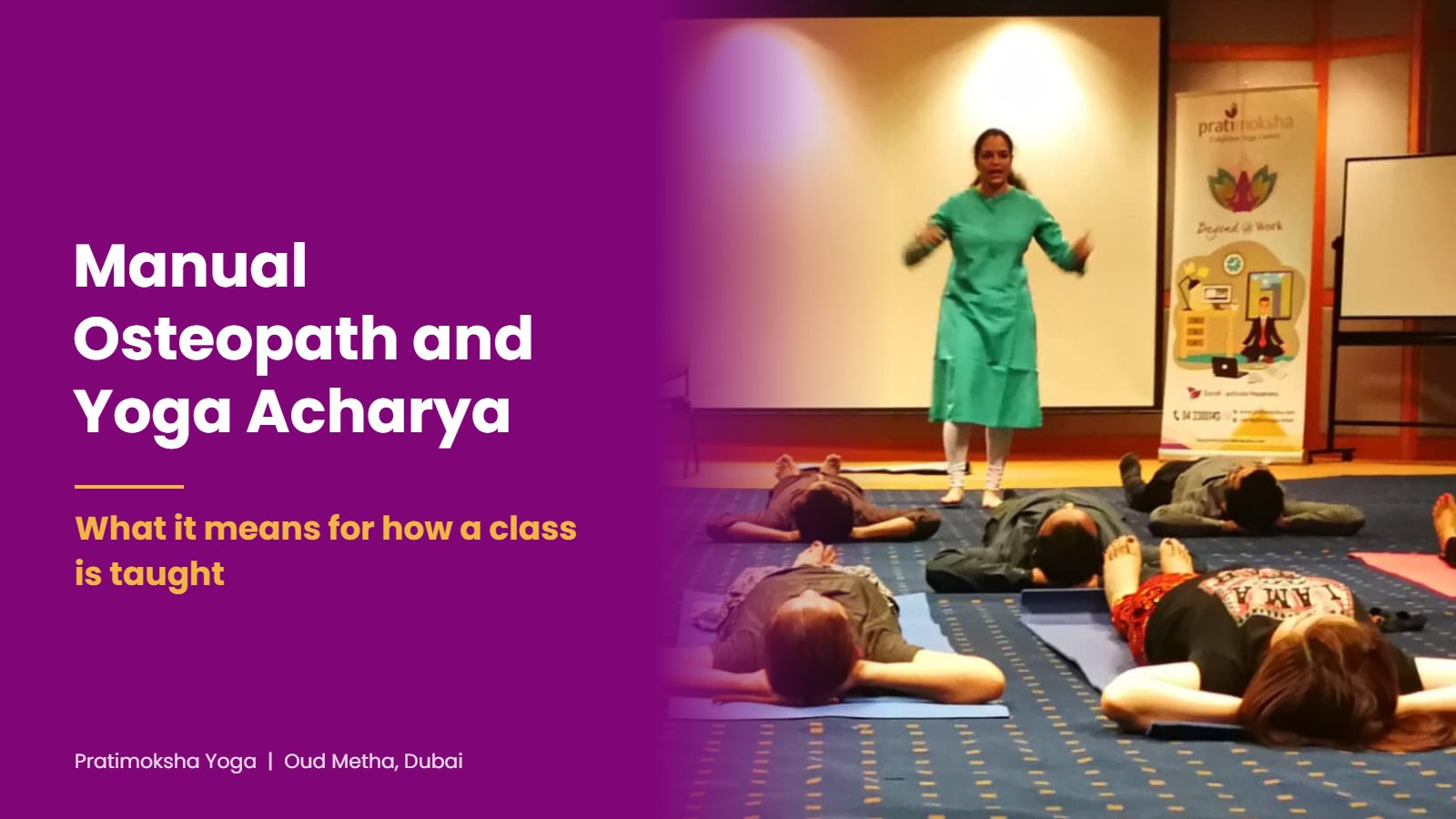
Each, on its own, leaves something out. An osteopath without the yogic frame sees mechanics and can miss the mind that is holding its breath. A yoga teacher without anatomical training sees a pose and can miss the hip quietly rotating to make it possible. Lalitha has taught classical yoga in Dubai for more than 20 years with both kinds of knowing in the room at once.
What trained hands notice first
For an osteopath, the outline of a pose is rarely the first thing worth watching. Attention goes to the places where effort leaks from one part of the body into another:
- A front knee that drifts inward in a warrior pose, loading the inner joint instead of the muscles around it
- A shoulder that rides up toward the ear in downward dog, pushing the weight down into the wrist
- A lower back that rounds early in a forward bend because the hamstrings and hips will not let the pelvis tilt
- A clenched jaw or a held breath during a balance, effort the posture itself does not need
- One side of the body consistently working harder than the other, a habit that follows people from a Business Bay office chair onto the mat
Each of these looks minor in a single class. Repeated four times a week for a year, they are exactly the kind of load the Sydney researchers watched turn into pain.
For people who spend the day driving across Dubai and then sitting through meetings, the patterns that reach the mat are the patterns of sitting: tight hip flexors, a head carried forward of the shoulders, a chest that has forgotten how to open. A teacher who can read those patterns in the first few minutes of a class can choose a sequence that undoes them instead of adding to them.
Adjustments that point instead of push
The hands-on adjustment has a mixed reputation in yoga, and some of it is earned. A teacher pressing a student deeper into a forward bend can take a hamstring or a disc somewhere it was not ready to go. The osteopathic use of touch runs the other way. A light hand on the shoulder blade tells the student where the movement should start. A palm on the sacrum shows which way the pelvis needs to tilt. The student does the work. The hand only points.
Students are asked before anyone touches them, and a verbal cue, a block or a strap does the same job for anyone who prefers no contact. Props carry real weight in the classical hatha taught at the studio for the same reason: they let a body find the shape without being forced into it.
This matters more with age. The Alabama figures showed the highest injury rate among people over 65, the group most likely to be told that yoga is the safe option. Older students at the studio get the same careful reading of the body, with more props and more patience.
Steadiness and ease, felt through the hands
Patanjali’s Yoga Sutras ask that a posture be sthira and sukha, steady and at ease. For a Yoga Acharya, that line describes the quality of attention a practice should have. For a manual osteopath, it is also something that can be felt: steadiness shows up as a joint that holds without strain, ease as tissue that has stopped guarding. The two readings meet in the same body.
Pratimoksha’s approach to yoga therapy grows out of that meeting. A session starts with how a student’s body is moving that day, and the sequence follows from there. Alignment over intensity is the working rule, so a pose held well at half depth counts for more than a full expression bought with a twisted knee. Ahimsa, non-harm, applies first to the student’s own joints. I think this is the least glamorous part of the method and the part that matters most, because it is what lets people keep practicing for decades instead of months.
Four days to see the method up close
The quickest way to understand what the two titles mean is to be assessed by them. From 11 to 14 November, the studio in Oud Metha is offering a free one-on-one Yoga Body Check: a structural look at posture and movement, a body type assessment, and time to talk through what the findings mean. Slots run from 7:00 am to 12:30 pm and from 4:00 to 8:30 pm between 11 and 13 November, and from 4:00 to 8:30 pm on 14 November.
Anyone in Dubai who has wondered why one particular pose never feels right can contact the studio to reserve a slot. Those who would rather begin with a regular class can book a trial session and see the same eye at work in a group.




0 Comments