
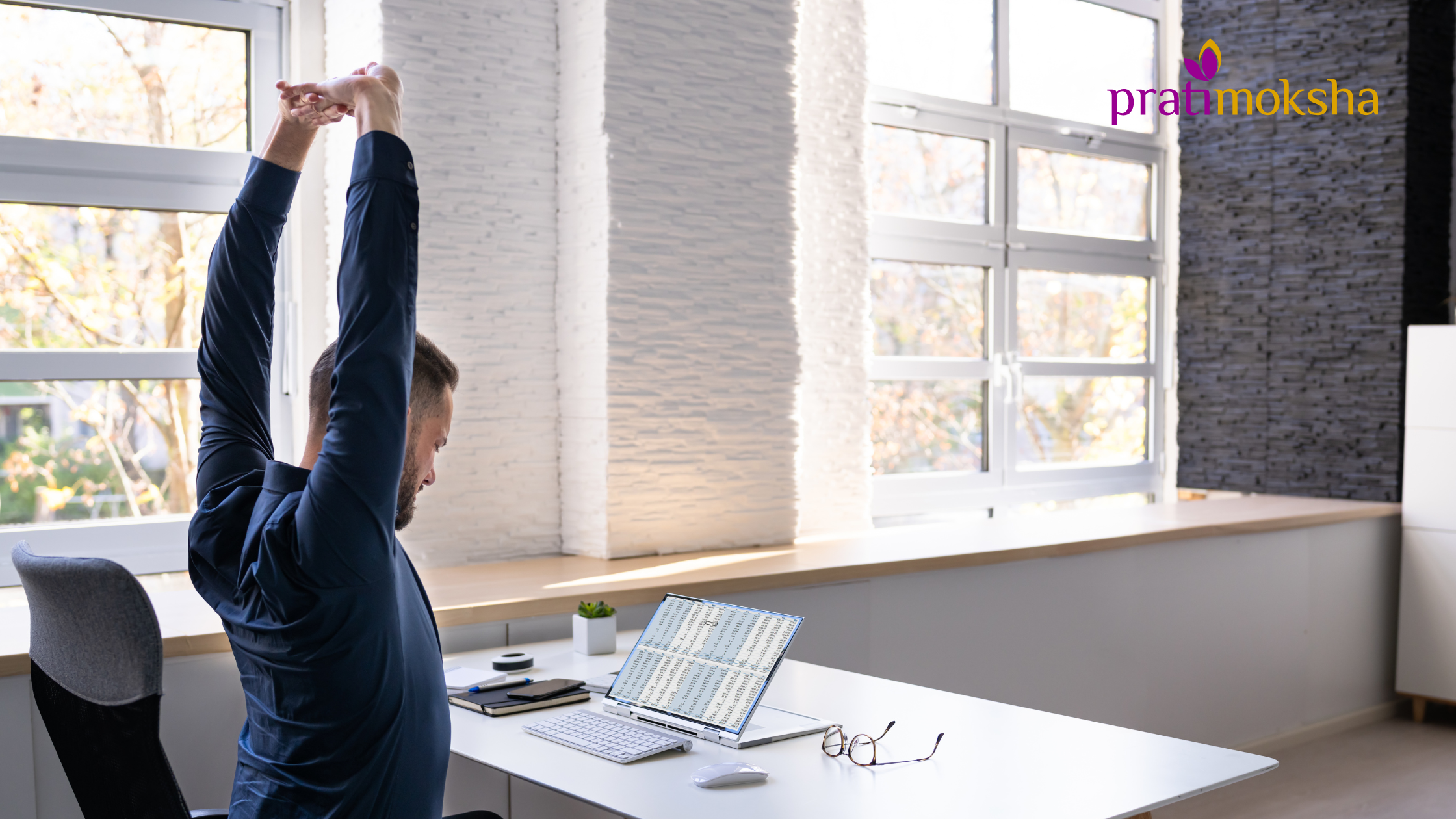
Twenty minutes. That is often all an office session gets, and it changes almost everything about how the practice is built.
A 2023 workplace wellness survey by the Chartered Institute of Personnel and Development in the UK found that short, recurring wellness interventions during the workday were associated with better sustained participation than longer sessions scheduled around it, largely because people do not have to reorganize their day to fit them in. Office yoga works on the same logic. The session has to fit inside the day, not the other way around.
Pratimoksha’s at-home and in-office private yoga sessions were built with this constraint in mind, and an office visit looks noticeably different from a home session as a result.
Where it happens
A meeting room with the door closed. A quiet corner near a window in Business Bay or DIFC. Occasionally a rooftop terrace, when the season allows it. The teacher works with whatever space is available, which is rarely a dedicated studio setup. This is one of the more practical realities of bringing yoga into a workplace: the room was designed for meetings, not movement, and the session has to adapt to that rather than the reverse.
What actually gets taught
Full asana sequences are usually not the point here. A working body in office clothes, on carpet, with thirty minutes before the next call, needs something different from a ninety-minute studio class. Office sessions tend to focus on:
- Seated and standing stretches that release the neck, shoulders, and hips after hours at a desk
- Breath work aimed at resetting focus before an afternoon of meetings, not building physical endurance
- Short, targeted sequences for whatever a desk job aggravates most, often the lower back or wrists
- A brief closing period, even if only two or three minutes, since stopping abruptly undoes some of the value of what came before
The difference privacy makes
A one-on-one office session removes something that a group corporate class cannot: the audience. Some professionals feel awkward stretching in front of colleagues, no matter how casual the office culture. A private visit strips that out entirely. The teacher works with one person, in one room, and the rest of the office does not need to know it happened at all.
Why the short format still counts
Twenty minutes sounds too brief to matter, and on paper it might be. In practice, a short session repeated consistently tends to outperform an occasional long one, mostly because consistency is the variable that actually determines whether a practice sticks. Pratimoksha’s approach, shaped by founder Lalitha Viswanath’s emphasis on steady, disciplined practice over intensity, fits naturally into this format. The point was never to exhaust someone in a spare meeting room. It was to give the body and the mind a few honest minutes before the next call starts.
Who this suits
Executives with back-to-back schedules across Dubai’s business districts are the obvious fit, but the format works just as well for smaller teams who want the option without committing to a full corporate wellness program. It sits somewhere between Pratimoksha’s corporate yoga offering, which is built for groups, and the individual program, which is built for one person’s longer-term progress. An office private session borrows from both: individual attention, delivered on a workday’s actual clock.
For anyone weighing whether a short in-office session could realistically fit into a demanding week in Dubai, the most useful next step is a direct conversation about scheduling through Pratimoksha’s contact page.



0 Comments