
For a lot of developers, the first warning arrives at the fingertips. A tightness along the forearm after a long debugging session, a thumb that aches from the trackpad, a wrist that clicks when it turns. The neck comes later. A 2022 survey by physiotherapy researchers at the University of Sharjah asked 506 young adults working at software and technology firms in and around Sharjah about work-related musculoskeletal problems, and three in four reported them. The lower back led at 48 percent, shoulders and neck followed at around 40 percent each, and one in five had pain in the wrists or hands.
Yoga has a small but interesting record with that last group. In a randomized trial published in JAMA in 1998, Marian Garfinkel and colleagues gave people with carpal tunnel syndrome twice-weekly sessions of upper-body yoga postures and relaxation. Compared with people using a wrist splint or no treatment, the yoga group gained grip strength and reported less pain. The study was small, with 42 people completing it, and a commentary published alongside it called the findings preliminary. It still points somewhere useful: the wrist responds to what happens in the shoulder and the rest of the arm.
Technology work in Dubai is spread across Dubai Internet City, the fintech offices of DIFC and the start-ups around Business Bay, and the working posture looks much the same in all of them. Two screens, a laptop, a mouse on one side, and long stretches of concentration. It is ordinary modern work, done well. It also asks the body for something very specific.
Small movements, thousands of times a day
General office work and coding share a chair, but the load lands differently. A developer’s day is built from patterns most desk workers do far less of:
- Fast, fine finger work on the keyboard and shortcuts, which keeps the forearm muscles under low, constant tension for hours
- One hand on the mouse or trackpad, so one shoulder sits forward and slightly lifted while the other rests
- Dense text on screen, which draws the head toward the monitor and the chin forward to read small fonts
- A second monitor set off to the side, holding the neck turned in one direction for most of the afternoon
- Deep focus, the state developers prize most, which is also the state that switches off the small signals telling the body to shift
- Late releases and on-call nights, finished on a laptop balanced on the knees
That fifth point matters more than it looks. A clerk answering emails gets up, takes a call, walks to a printer. A developer in the middle of a hard problem can sit almost motionless for two hours and feel fine until the moment they stand.
The chain from fingertip to neck
The muscles that move the fingers run the length of the forearm and attach near the elbow. The elbow hangs from the shoulder, and the shoulder blade floats on the ribs, anchored by muscles that also hold the neck. Tension in one link travels along the others. A sore wrist can be the end of a story that started with a shoulder pulled forward by the mouse.
That is why a wrist complaint in classes taught in the approach of Lalitha Viswanath, whose background as a manual osteopath shapes how the studio reads the body, gets checked at the shoulder and the neck before anyone stretches the wrist. Stretching the end of the chain while the top stays locked gives a few minutes of relief and little else.
The same logic shapes the musculoskeletal therapy offered at the studio: the sequence follows the whole arm and spine, with the breath slowing down enough for the tissue to let go.
A short practice that fits between commits
None of this needs a mat. A few minutes at the desk, two or three times a day, works on the right parts of the chain:
Spread the fingers wide, then make a slow, soft fist, ten times. Press the palms together in front of the chest and lower the hands until the forearms feel a gentle stretch, then reverse the hands, backs touching. Rest the palm on the desk with the fingers pointing back toward the body and lean away a little. Draw both shoulder blades toward each other and down, hold for a breath, let go. Tuck the chin straight back, as if making a double chin, five times. Then look away from the screen at something far off and take three slow breaths through the nose.
The setup matters as much as the stretches. The top of the screen sits at eye level, the keyboard close enough that the elbows stay by the sides, the mouse right beside the keyboard instead of out at arm’s length, and the feet flat on the floor. A laptop used all day needs a stand and a separate keyboard. Without them, no stretch can keep up.
Stop if any of it brings on numbness, tingling or sharp pain. Pins and needles at night, a weakening grip or a hand that goes numb while typing need a doctor’s assessment first, and yoga therapy works alongside that rather than in place of it.
Discipline in a small dose
Classical yoga has a word for this kind of practice: abhyasa, steady effort repeated over time. Patanjali pairs it with vairagya, a kind of loosening of the grip. Developers understand both better than most. Good code comes from small, consistent commits rather than heroic all-nighters, and the hardest bugs give way only when the mind stops forcing them.
The body works on the same terms. Three minutes of attention every few hours does more than a punishing weekend workout that tries to undo a week of stillness. Here, awareness over achievement works as a maintenance schedule.
Pratyahara, the withdrawal of the senses, has a practical version too: a minute with the eyes off every screen, resting on something far away.
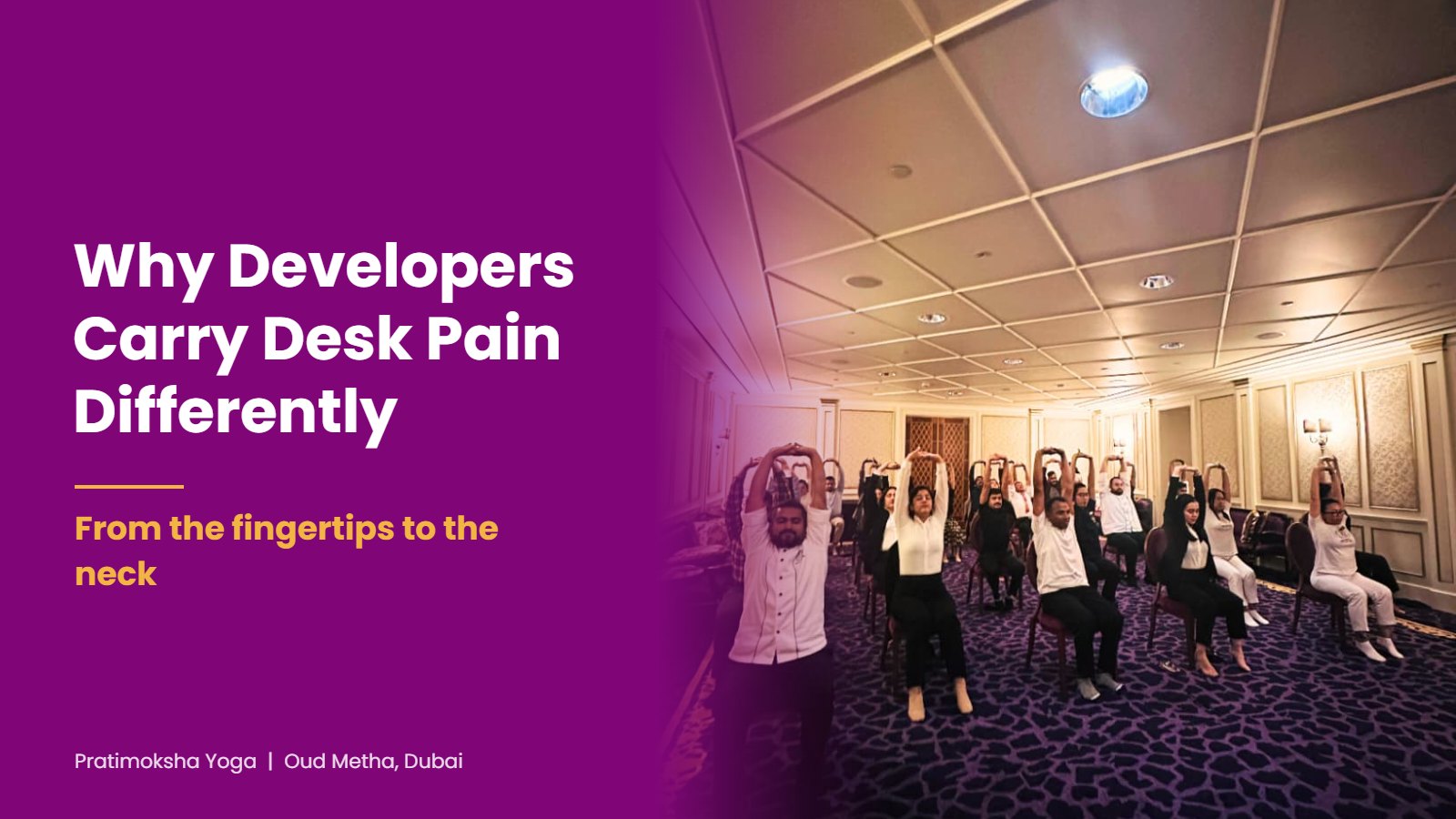
For teams, the studio also runs corporate sessions built around exactly this kind of desk load, so a whole engineering floor can learn the routine together.
Monitoring the one system nobody logs
Software teams track uptime, latency and error rates with real care. The developer at the keyboard rarely gets the same attention until something breaks. Anyone working in Dubai who has started noticing the forearm or the neck before the end of the day can book a trial session at the studio in Oud Metha, a short drive from Healthcare City and Bur Dubai, and find out which link in the chain is doing the complaining.




0 Comments