
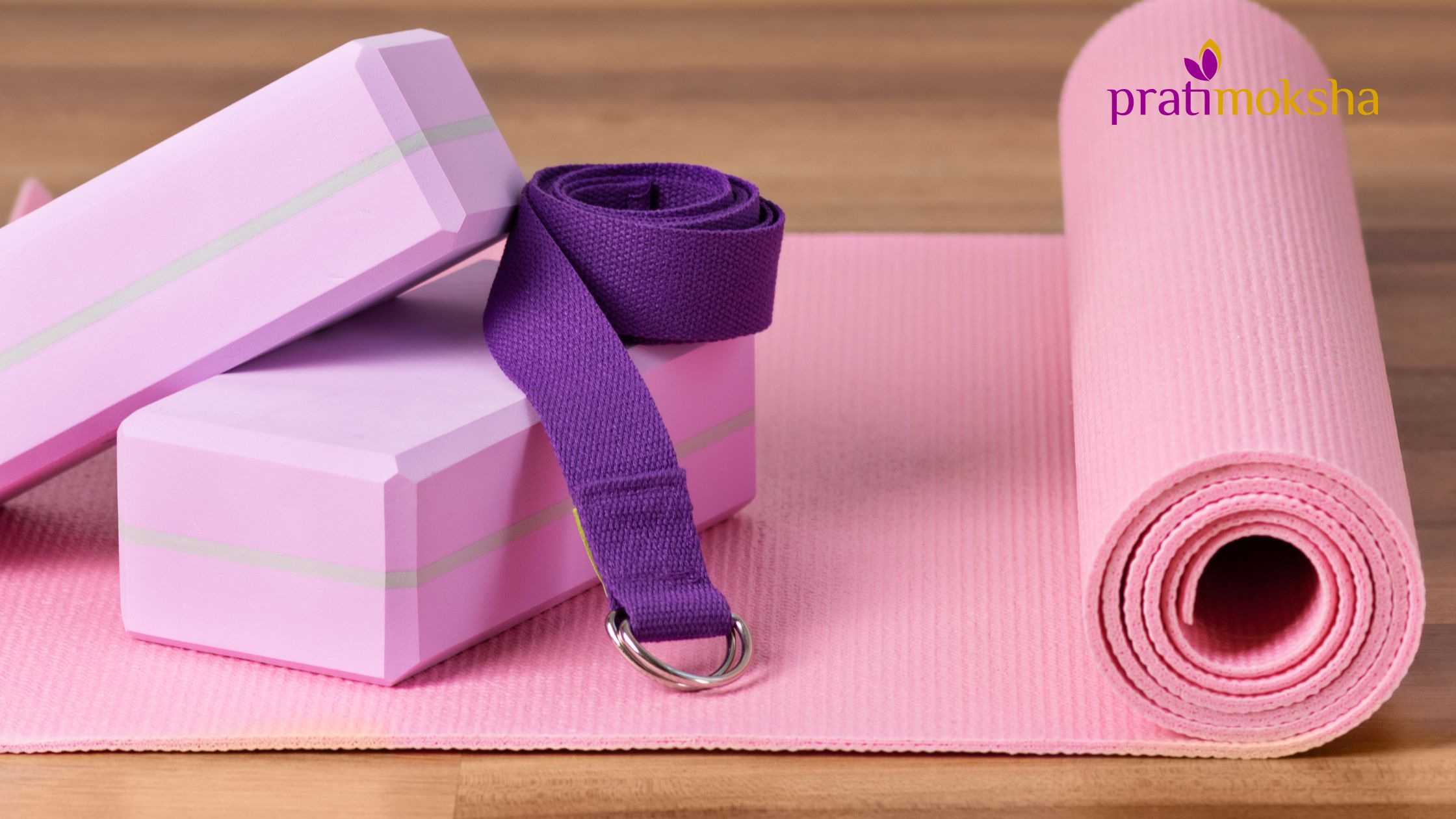
A home yoga session does not need a home studio. It needs about six feet of clear floor and a willingness to move the coffee table.
A 2026 systematic review in the International Journal of Spa and Wellness, led by researchers Harini K.N. and Savithri Nilkantham, examined 44 studies on the role of props in yoga practice and found that blocks, straps, and bolsters improve alignment, accessibility, and safety far more than they signal a lack of ability. That finding runs against a common assumption: that private sessions require specialized equipment to feel legitimate. The research says otherwise. What most home practices actually need is a clear floor, a mat, and one or two simple props brought by the teacher.
What Pratimoksha’s teachers actually bring
For at-home and in-office private yoga sessions, the teacher typically arrives with a portable kit: a mat if the student does not already have one, a block or two, and occasionally a strap. That is usually the full list. Nothing about a private session in a Dubai apartment or villa requires a dedicated room, a mirror wall, or equipment purchased in advance.
Why space matters more than square footage
The actual requirement is clearance, not size. A six-by-six-foot patch of floor, cleared of furniture and rugs that slide, is enough for almost any sequence a private session might include. This holds whether the session happens in a compact one-bedroom in Downtown Dubai or a larger living area in a villa in Arabian Ranches. The difference between those two settings is comfort, not capability. Both work.
What the props are actually for
The systematic review’s central finding matters here: props are not a workaround for weakness. They are tools that let a teacher correct alignment with more precision than the body alone allows. A block under the hand in a standing pose changes how the shoulder sits. A strap looped around the foot in a seated forward fold changes how the spine lengthens. In a group class, props sit in a pile at the back of the room and students self-select. In a private session, the teacher chooses them deliberately, based on what that specific body needs that day.
A short list of what a home session typically draws on:
- A yoga mat, either the student’s own or one the teacher brings
- One or two blocks, mainly for standing poses and seated support
- A strap, used less often but useful for tighter hamstrings or shoulders
- A cushion or folded blanket, for seated breath work or closing stillness
- Nothing else, in most cases
What gets in the way more than people expect
Space is rarely the real obstacle. Flooring is. Hard tile common in many Dubai apartments can be uncomfortable without a proper mat underneath, and a thick rug does the opposite problem, making balance poses unstable. Air conditioning vents pointed directly at a practice area are the other frequent issue, since a strong current of cold air changes how a body should be positioned for a session. None of this requires renovation. It requires the teacher noticing it in the first few minutes and adjusting the layout of the session around it.
Where this differs from what people picture
Most people imagining an at-home yoga session picture something closer to a boutique studio: soft lighting, a designated corner, maybe a diffuser running in the background. Pratimoksha’s private sessions do not depend on any of that. The instruction itself, shaped by founder Lalitha Viswanath’s classical training, treats the teacher’s attention as the actual asset in the room. The décor is irrelevant. What matters is whether the teacher can see how the body is moving and adjust in real time, which a cleared six-by-six patch of floor allows just as well as a converted studio room would.
A note on office equipment
For in-office sessions, the requirements shrink further. A meeting room floor, a yoga mat the teacher carries in, and enough space to stand with arms extended is generally sufficient. Most office sessions skip props entirely, since the sequences tend toward standing stretches and breath work rather than floor-based postures that benefit from blocks or straps.
Setting up before the first visit
Before a first session, Pratimoksha’s team usually asks a few quick questions: what kind of flooring is available, whether there is a rug or open tile, and roughly how much clear space exists in the room being used. This takes a few minutes and saves the first session from being spent rearranging furniture. It also lets the teacher bring exactly what that space will need, rather than a generic kit built for an average living room that may not match the one they are walking into.
This is, in the end, one of the more practical advantages of the individual program format extended into a home or office setting. The equipment list stays short because the session is built around a person, not a studio’s fixed inventory. For anyone unsure whether their apartment or office has enough room to make this work, the simplest way to find out is to ask directly through Pratimoksha’s contact page.



0 Comments