
Most of us know the feeling, even if we have never named it. A low hum of unease that sits just beneath the surface of a normal day. You get through your work, your meetings, your commute, your evenings — and yet something feels slightly off-kilter. Not dramatic enough to call a crisis. Just unsettled.
In Dubai right now, that feeling is more widespread than people tend to admit out loud.
When Stability Becomes a Practice, Not a Given
The word “grounding” gets used a great deal in wellness circles, often loosely. In the classical yogic framework, however, it points to something specific — the cultivation of stability, both physical and mental, as a deliberate and ongoing practice. Not a state you arrive at once and maintain automatically, but something you return to, again and again, through conscious effort.
This matters because grounding is not a personality trait. It is not something certain people have and others lack. It is a capacity that can be developed, and one that becomes genuinely essential when external circumstances are in flux.
The yogic concept most closely tied to this quality is sthira — steadiness. It appears in the Yoga Sutras alongside sukha, ease, as the dual quality that asana practice is meant to develop. Not rigidity, and not forced calm, but a stable, responsive quality of presence. The kind that allows you to remain oriented even when the environment around you is not.
What Grounding Actually Looks Like in Practice
There are three domains where grounding practices tend to have the most immediate and measurable effect — the breath, the body, and attention itself. Each works through a different mechanism, and each is worth understanding on its own terms.
The breath is often the fastest route in. When the nervous system is running in a state of chronic low-level activation — which is the physiological reality behind that background hum of unease — the breath shortens and rises into the chest. Lengthening the exhale signals the parasympathetic nervous system to engage. This is not metaphor. It is physiology. A simple practice of extending the exhale to roughly twice the length of the inhale, repeated for five to ten cycles, creates a measurable shift in the body’s stress response. This is the foundation of many pranayama practices and requires nothing other than a few undisturbed minutes.
Restorative postures work through a different but complementary mechanism. When the body is fully supported — lying down, joints released, no muscular effort required — the proprioceptive system begins to recalibrate. The body stops scanning for threat. Postures like supported child’s pose, legs up the wall, or a simple supine rest with weight on the abdomen can shift the quality of the nervous system within minutes. This is not rest as avoidance. It is rest as active recovery, and it is increasingly recognised in both clinical and workplace wellness research as one of the most under-utilised tools available.
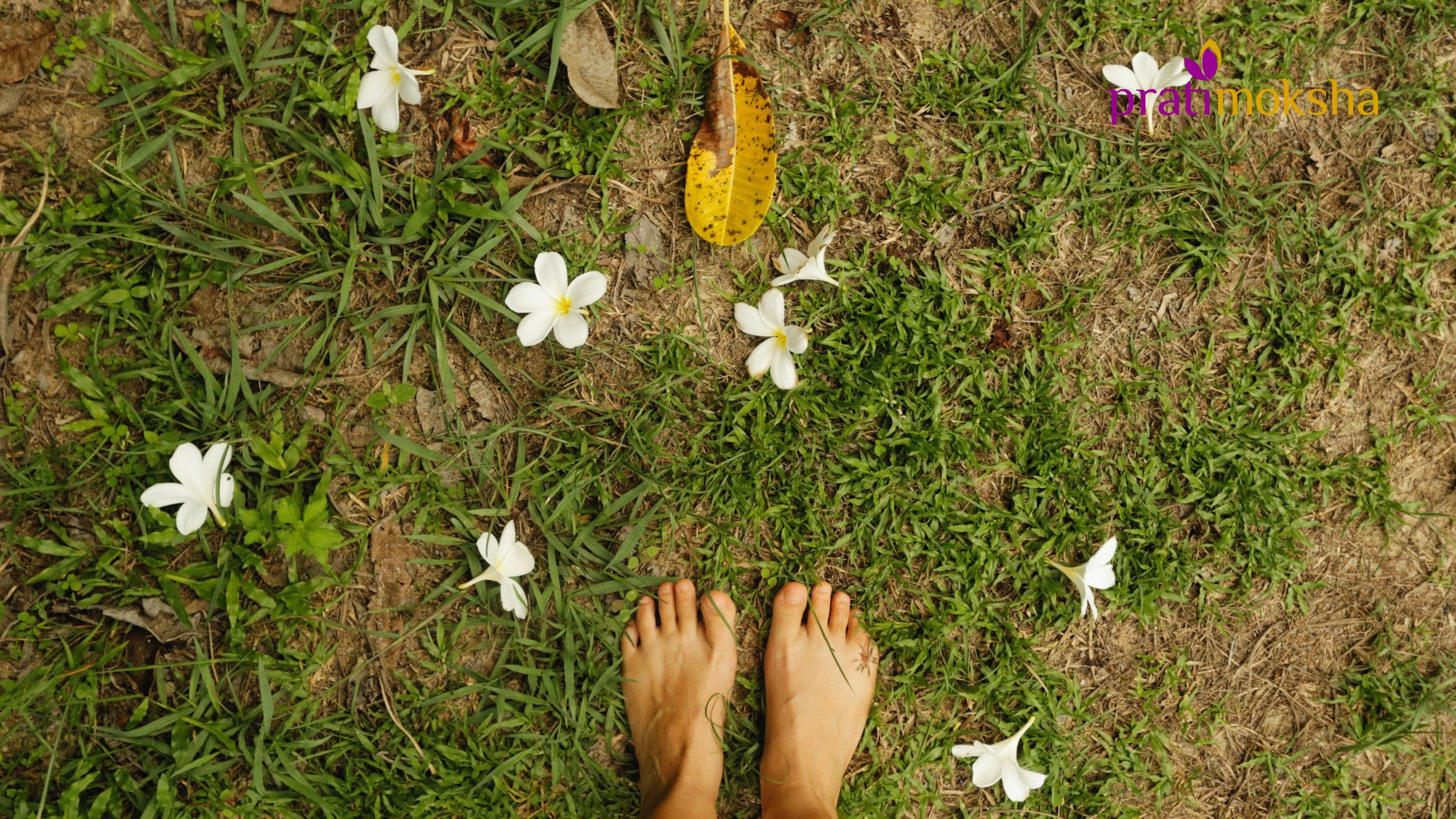
Walking meditation is less commonly discussed but particularly suited to life in a city. It requires no equipment, no studio, and no formal session. The practice involves slowing the pace of walking considerably and placing full attention on the physical sensation of each step — the contact of the foot with the ground, the transfer of weight, the rhythm of movement. Done consistently, even for ten minutes, it interrupts the mental loop that keeps stress cycling and returns attention to the present moment. For Dubai residents who spend long hours at a desk and limited time outdoors, it can also serve as a simple reintroduction to the physical body.
The Specific Challenge of Uncertainty
Grounding practices are useful in general, but they become particularly important during periods of uncertainty — and uncertainty has a specific quality that makes it harder to manage than concrete difficulty. When something goes wrong in a defined way, the mind can problem-solve. When the situation is genuinely unclear — economically, professionally, personally — the mind keeps running without resolution. It rehearses scenarios, revisits decisions, anticipates outcomes that may never arrive. This is exhausting in a way that is difficult to explain to someone who has not experienced it, and common to an extent that current data makes very clear.
A 2024 report on mental health in the UAE found that anxiety disorders have seen a marked increase among working-age adults, with uncertainty about employment and financial stability cited among the primary contributing factors. In Dubai, where so much of professional and personal identity is tied to performance and progress, this kind of uncertainty can feel particularly destabilising.
The yoga therapy framework at Pratimoksha addresses this not by treating anxiety as a malfunction to be corrected, but by building the internal resources that allow a person to remain functional and present within difficulty. That distinction matters. The goal is not to eliminate discomfort. It is to develop the capacity to carry it without being defined by it.
Why Regularity Matters More Than Intensity
One of the principles that Lalitha Viswanath returns to consistently in her teaching is that a steady, modest practice will always outperform an intense but sporadic one. This applies especially to grounding work. A ten-minute breathing practice done daily builds something qualitatively different from an hour-long session once a week. The nervous system learns through repetition and consistency. Grounding becomes available as a resource — something you can access in a meeting, on the road, before a difficult conversation — only when it has been practised enough to become second nature.
This is why the classical approach to yoga was never structured around peak experiences or dramatic transformation. It was structured around the slow accumulation of awareness, practised with enough regularity that it gradually reshapes how you move through the world.
Beginning Where You Are
If you are in Dubai right now and the ground feels less solid than you would like, the invitation is not to wait for conditions to improve before beginning a practice. The practice is precisely what helps you stop waiting.
Pratimoksha offers individual sessions tailored to where you are starting from, as well as a range of yoga classes that incorporate breathwork and restorative elements alongside the physical practice. If you would like to experience the approach before committing to anything, a trial session is available — a quiet starting point, with no pressure attached.
Steadiness is not something you find when life becomes easier. It is something you build so that you can tap into it when life feels heavy, chaotic, and uncertain.


0 Comments