
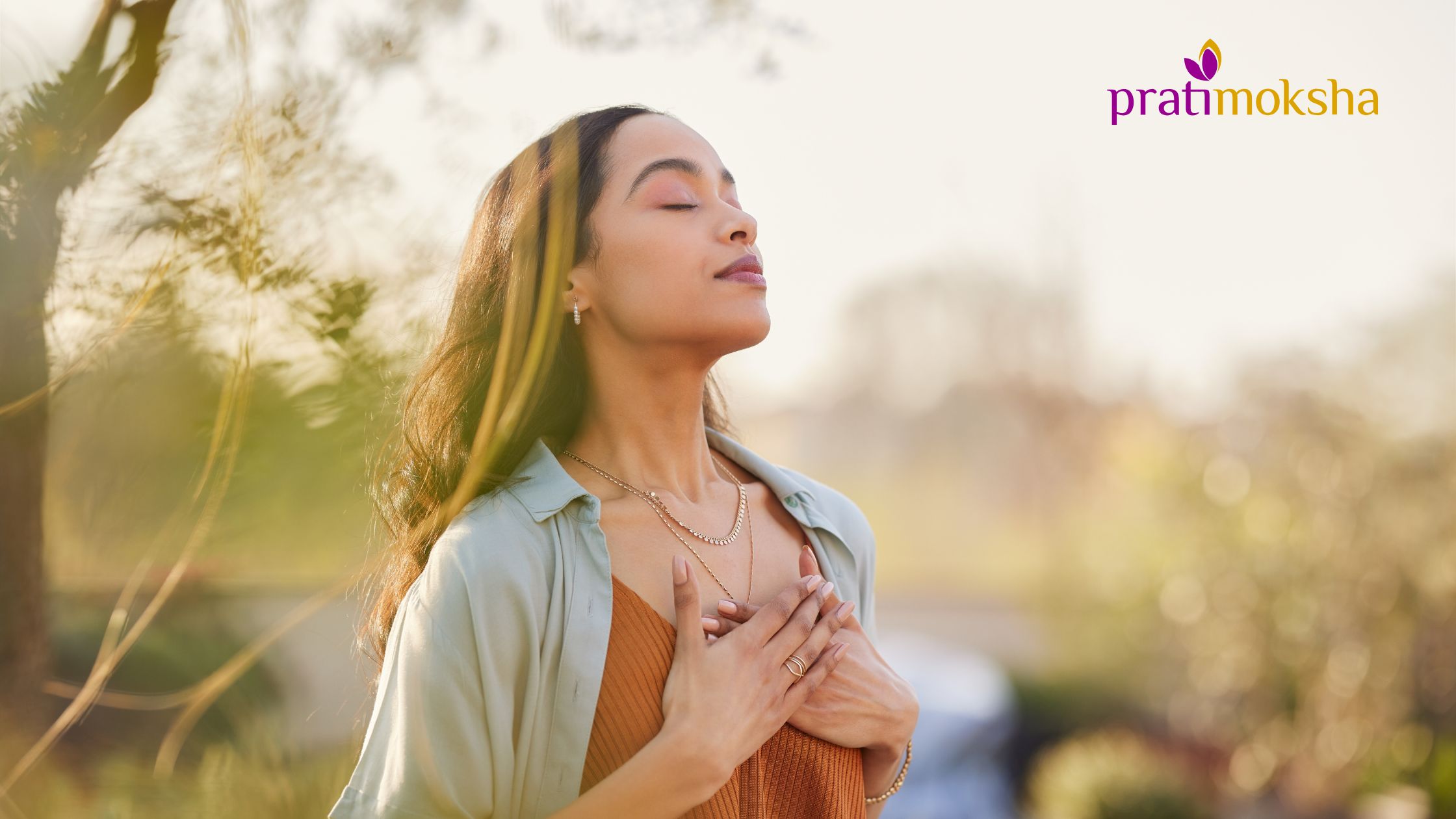
Ask an advanced practitioner what separates their practice from a beginner’s, and most won’t mention flexibility. They’ll mention breath.
That’s not modesty. It’s accurate.
A 2025 systematic review in Yoga Mimamsa, covering pranayama techniques including Ujjayi, Nadishodhana, and Bhastrika, found consistent physiological and psychological effects across practitioners, changes that compounded with sustained practice rather than plateauing early. A separate 2025 clinical trial published in Annals of Neuroscience, testing six weeks of daily Anulom-Vilom breathing, found measurable drops in both heart rate and blood pressure in regular practitioners. Not a one-time calming effect. A cumulative one.
None of this happens by accident. It happens because breath, at the advanced level, stops being background and starts being the main event.
Where beginners and advanced practitioners actually differ
A beginner treats breath as instruction. Inhale here, exhale there, a cue to follow while the real work happens in the posture.
An advanced practitioner treats breath as the posture. The physical shape becomes secondary, almost incidental, to what’s happening with the breath moving through it.
This shift doesn’t happen quickly, and it can’t be rushed. Most students spend a year or more in consistent practice, often through Dubai’s regular studio schedules, before breath starts to feel like anything more than a technique layered onto the poses.
Ujjayi as a case study in depth
Ujjayi, the audible, throat-constricted breath common in vinyasa and Ashtanga styles, is a useful example of how the same technique means something different at different stages.
A beginner learns ujjayi as a way to regulate pace and stay present during a flow. Useful, but fairly mechanical.
An advanced practitioner experiences ujjayi as a continuous feedback loop. The sound of the breath tells them exactly how much effort they’re exerting, whether they’re rushing, whether tension has crept into the throat or the jaw. The breath becomes a diagnostic tool, not just a rhythm to follow.
Lalitha Viswanath, whose teaching at Pratimoksha spans close to two decades, describes this shift as the real marker of advancement. Not deeper backbends. A breath that has become genuinely intelligent.
Why advanced practice demands more breath training, not less
There’s a common assumption that once someone reaches an advanced level, breath work becomes less necessary, since the basics are already there. The opposite tends to be true.
Advanced postures place more demand on the nervous system, not less. Deeper backbends, longer holds, and more complex transitions all require a breath capable of staying steady under real physical strain. Without that steadiness, advanced practice tends to become forceful rather than skillful, pushing through positions rather than moving into them.
This is why Pratimoksha’s Prana & Beyond program continues well past the point most students would consider themselves “done” with breath training. Retention work, ratio practice, and nostril-specific techniques all get more refined, not less, as a student’s physical practice advances.
How this plays out for practitioners in Dubai
For many students, advanced practice develops alongside demanding professional lives across Dubai, and the two aren’t as disconnected as they might seem.
A nervous system trained to stay steady through a difficult breath retention tends to handle a tense negotiation in Business Bay with a bit more composure, too. That’s not a coincidence. The same regulation being trained on the mat is the regulation being called on everywhere else.
Dubai’s pace rarely slows down for anyone’s practice schedule. Students who reach an advanced stage here have usually built breath discipline specifically because their daily lives gave them no shortage of opportunities to practice staying steady under pressure.
Where breath training eventually leads
For students who continue deep into breath work, the natural next step is often meditation. A settled, trained breath is what makes sustained concentration possible at all, which is why dhyana meditation typically comes after real progress in breath work, not before it.
Others stay focused on refining the breath itself indefinitely, treating it as its own lifelong discipline rather than a stepping stone toward something else. Both paths sit comfortably within Pratimoksha’s broader signature program.
There’s no ceiling on how refined this work can become. Students who’ve practiced for a decade still describe finding new layers in a breath pattern they thought they’d already mastered years earlier.
For anyone curious what advanced breath work actually feels like, rather than what it sounds like described secondhand, the clearest way to find out is directly. A trial session at the studio in Oud Metha is a reasonable place to start that conversation.


0 Comments