
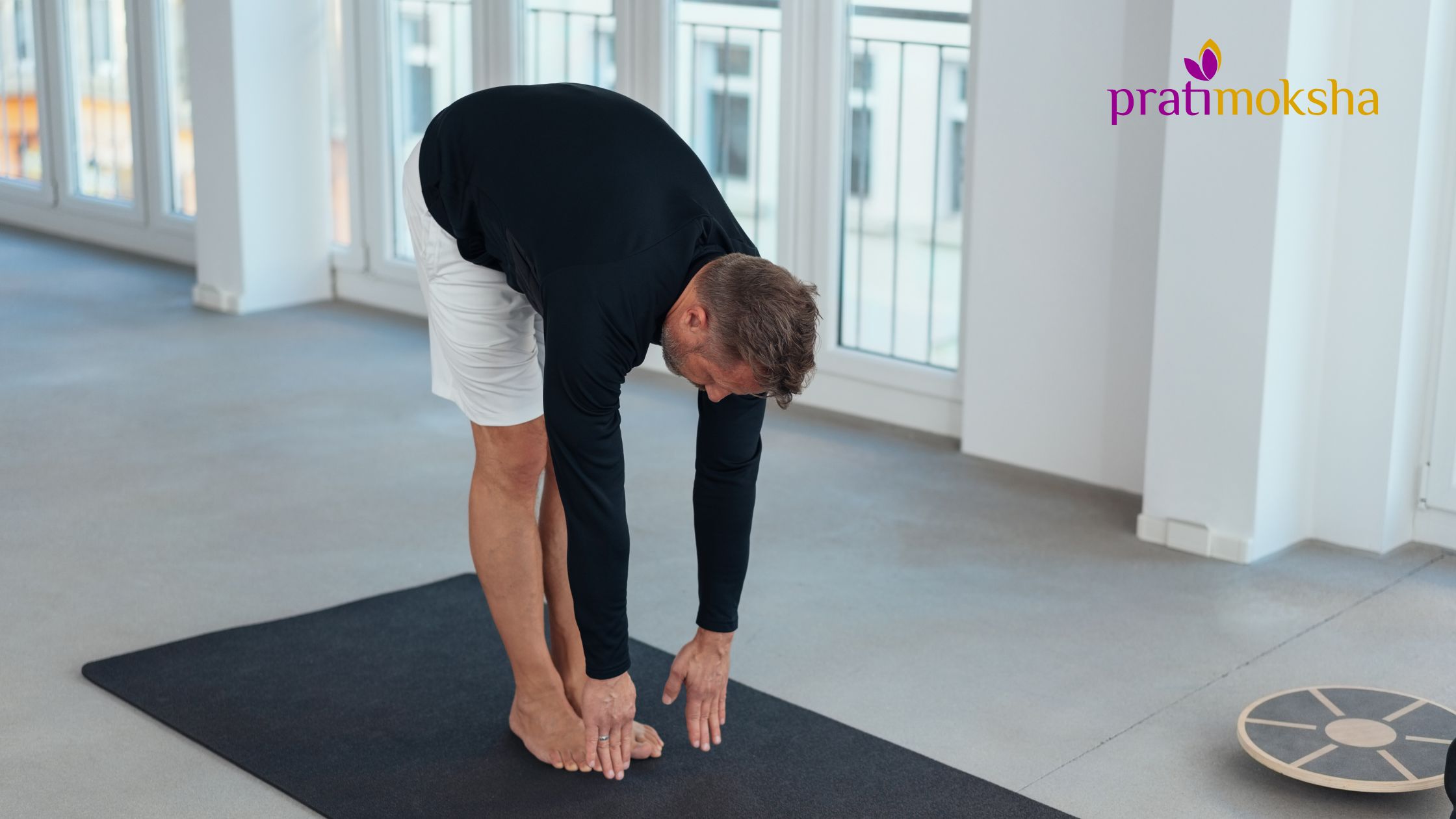
Go to any gym in Dubai on a weekday evening and you’ll find people stretching before or after a workout. Hamstring pulls, shoulder rolls, a few minutes on a foam roller. It looks, from a certain angle, like the opening ten minutes of a yoga class. Same mat. Sometimes the same poses. So the question is reasonable: if someone is already stretching regularly, what exactly would yoga add?
The answer goes further than most people expect. A 2025 systematic review published and indexed on ScienceDirect examined thirty-three yoga intervention studies and found consistent evidence that yoga improves body awareness across multiple dimensions, including the capacity to notice internal sensations, regulate attention, and respond to physical signals rather than override them. Stretching, by contrast, targets tissue length and muscle pliability. Both produce physical changes. Only one of them is designed to change the relationship between a person and their body.
What stretching actually does
Stretching is mechanical. It applies tension to soft tissue with the goal of increasing range of motion, reducing post-exercise soreness, or managing injury risk. It works, within its limits. Hamstrings lengthen. Hip flexors release. The body moves with less friction.
What stretching doesn’t do is ask anything of the mind. A person can stretch while watching television, while running through tomorrow’s schedule, while essentially being elsewhere. The body is being managed, not engaged. That distinction sounds abstract until you sit with it: the person doing the stretching is operating on the body from the outside, the way you’d service a machine.
Yoga begins from a different premise entirely.
Where the two practices diverge
A yoga posture, at least in the classical sense, is not a stretch with added breathing. The breath is not a relaxation technique layered on top of the physical work. It’s the mechanism through which the work happens. Breath directs attention inward. Attention changes what the body does. This is not a metaphor. The physiological relationship between breath, nervous system state, and muscular tension is well documented, and it’s the reason that the same posture done with controlled breath produces a different outcome than the same posture done without it.
A 2023 study comparing yoga postures and standard stretching techniques found that yoga kept prefrontal cortex oxygenation levels more stable during upper limb movements, suggesting that yoga postures engage the brain differently, not just the muscles. This matters because what yoga builds over time is not just flexibility. It’s a more accurate internal map of the body.
This is what classical yoga calls svadhyaya, self-study. Not introspection in a loose sense, but the deliberate practice of noticing what’s happening inside the body during movement, breath, and stillness. A stretch can release a tight hip. It cannot teach you why the hip is tight, or what you’re holding there, or what it means when the tightness returns every Monday morning.
What Hatha yoga actually trains
Hatha yoga is often described as the physical branch of yoga, which is accurate but incomplete. The postures in Hatha practice are held long enough for the nervous system to respond, not just the muscles. This is a meaningful difference. A quick stretch activates the stretch reflex, the body’s protective mechanism that limits range of motion to prevent tearing. Hold a position long enough with steady breath, and the nervous system gradually permits more depth, not because the muscle has lengthened, but because the body has registered that it’s safe.
Lalitha Viswanath teaches this distinction from the first session. The instruction is rarely “push further.” It’s more often “wait here and breathe.” Students who come from a gym background find this counterintuitive. They expect effort to look like effort. The quiet, attentive holding of a posture doesn’t feel like work until something in the body releases that has been braced for years.
What changes and what doesn’t
This matters for setting realistic expectations. Stretching and yoga overlap in some outcomes and diverge sharply in others:
- Range of motion improves with both, but yoga tends to produce more durable gains because the nervous system has been involved in the change, not bypassed.
- Stress reduction is possible with stretching but is incidental. In yoga, particularly breath-centered practice, it’s structural.
- Body awareness, the ability to notice internal physical states accurately, is specifically trained in yoga and largely untouched by stretching alone.
- Postural habits change more reliably with yoga practice because the mind is present and observing, not elsewhere.
- Recovery from physical and mental fatigue tends to be deeper after yoga than after a stretching session of equivalent duration.
The nervous system question
Most professionals in Dubai spend the majority of their day in a low-grade state of activation. Deadlines, screens, back-to-back meetings, the general hum of a high-output environment. The body adapts by keeping certain muscles chronically braced. The shoulders stay high. The jaw sets. The breath stays shallow. Stretching can work on the muscular component of this pattern. It can’t reset the underlying neurological driver.
Breath-centered yoga practice works on both simultaneously. The controlled, deliberate breath activates the parasympathetic nervous system, signaling safety to a body that has been running on alert. As the nervous system settles, the muscle bracing that stretching alone couldn’t shift often releases on its own. This is physiology. And it’s why people often leave a yoga class feeling different from how they leave a stretching session, even one that addressed the same areas of the body.
When stretching is the right tool
None of this is an argument against stretching. Targeted stretching is appropriate after intense physical training, during injury rehabilitation, and as a way to maintain mobility between yoga sessions. The question is whether stretching alone can deliver what people often hope it will: less physical tension, better sleep, a reduction in the chronic low-grade stress that accumulates in a city like Dubai.
For those specific outcomes, the mechanism matters. Stretching addresses the symptom. Yoga therapy and classical yoga practice are designed to address what’s driving it. For anyone curious about what a structured beginning looks like, the yoga classes at Pratimoksha are taught with this distinction built in from session one.




0 Comments