

Walk into most HR offices in Dubai and you will find a gym membership agreement somewhere in the filing system. It is one of those benefits that organisations adopt early, renew automatically, and rarely interrogate. It signals that the company cares about health. It looks good in a benefits summary. And for a portion of the workforce, it genuinely gets used.
But here is the question that rarely gets asked at renewal time: is it actually solving the problem it was meant to solve?
Two Different Answers to Two Different Questions
Before comparing corporate yoga and corporate gym memberships, it helps to be clear about what problem each one is designed to address.
A gym membership answers the question: how do we support employees who want to exercise? It is a resource for people who are already motivated to be physically active and need a convenient, subsidised place to do it.
Corporate yoga, when delivered well, answers a different question entirely: how do we help our workforce recover from the specific demands of professional life, develop resilience under pressure, and sustain performance over time?
These are not the same question. And conflating them is where most corporate wellness decisions go quietly wrong.
The Utilisation Gap Nobody Talks About
There is an uncomfortable truth sitting inside most corporate gym benefit programmes. The people who use them most are the people who needed them least. They were already active, already motivated, already managing their health independently. The gym membership made something they were going to do anyway slightly more convenient.
The people who most need support, those carrying the highest stress loads, managing chronic physical discomfort from years of sedentary work, or simply too depleted at the end of a ten-hour day to contemplate additional exertion, are almost never the ones walking through the gym doors.
This is not a character failing. It is a predictable consequence of how stress and depletion affect motivation. When the nervous system is running on empty, the prospect of adding a physically demanding activity to an already demanding day is not appealing. It is, for many people, genuinely not possible.
Corporate yoga removes this barrier in a way that gym access simply cannot, for several important reasons:
- It is delivered at or near the workplace, eliminating travel time entirely
- It fits within or adjacent to working hours rather than competing with personal recovery time
- It requires no particular fitness level, athletic background, or physical confidence
- It meets participants in a state of fatigue and works with that state rather than demanding energy the body does not have
- It is a shared experience that builds something collective, not an individual activity conducted in parallel
What Each Delivers Over Time
This is where the comparison becomes most instructive, because the outcomes of each approach over a twelve-month period are meaningfully different.
A corporate gym membership, used consistently by those who choose to use it, will improve the cardiovascular fitness and physical strength of that subset of your workforce. These are genuine health benefits. What it will not do is reduce stress across the organisation, improve collective focus and decision quality, address the musculoskeletal consequences of sedentary work for people who are not already exercising, or build any shared culture of recovery and awareness.
A structured corporate yoga programme, delivered consistently to the broader workforce, produces a different set of outcomes:
- Measurable reduction in perceived stress levels across participants
- Improved physical comfort for sedentary workers, particularly in the neck, shoulders, and lower back
- Developed capacity for self-regulation under pressure, which affects decision quality and interpersonal dynamics
- A visible organisational signal that recovery is valued, which influences engagement and retention
- Skills that participants carry with them beyond sessions, compounding in value over time
The corporate yoga beyond work programme at Pratimoksha is built specifically to deliver these outcomes, not as aspirational targets but as the designed intent of every session and the arc of the programme as a whole.
The Inclusion Argument
There is an equity dimension to this comparison that organisations in Dubai would do well to consider seriously.
A gym membership is implicitly designed for a particular kind of participant. Someone physically able, sufficiently motivated, with enough discretionary time and energy to exercise outside of working hours. In a diverse workforce, which describes virtually every organisation of any size in Dubai, this profile excludes a significant proportion of employees.
Senior professionals in their fifties managing joint pain. Women navigating hormonal health concerns. Employees with chronic conditions that make high-intensity exercise impractical. New parents operating on fragmented sleep. People for whom the gym is not a welcoming environment for cultural or personal reasons.
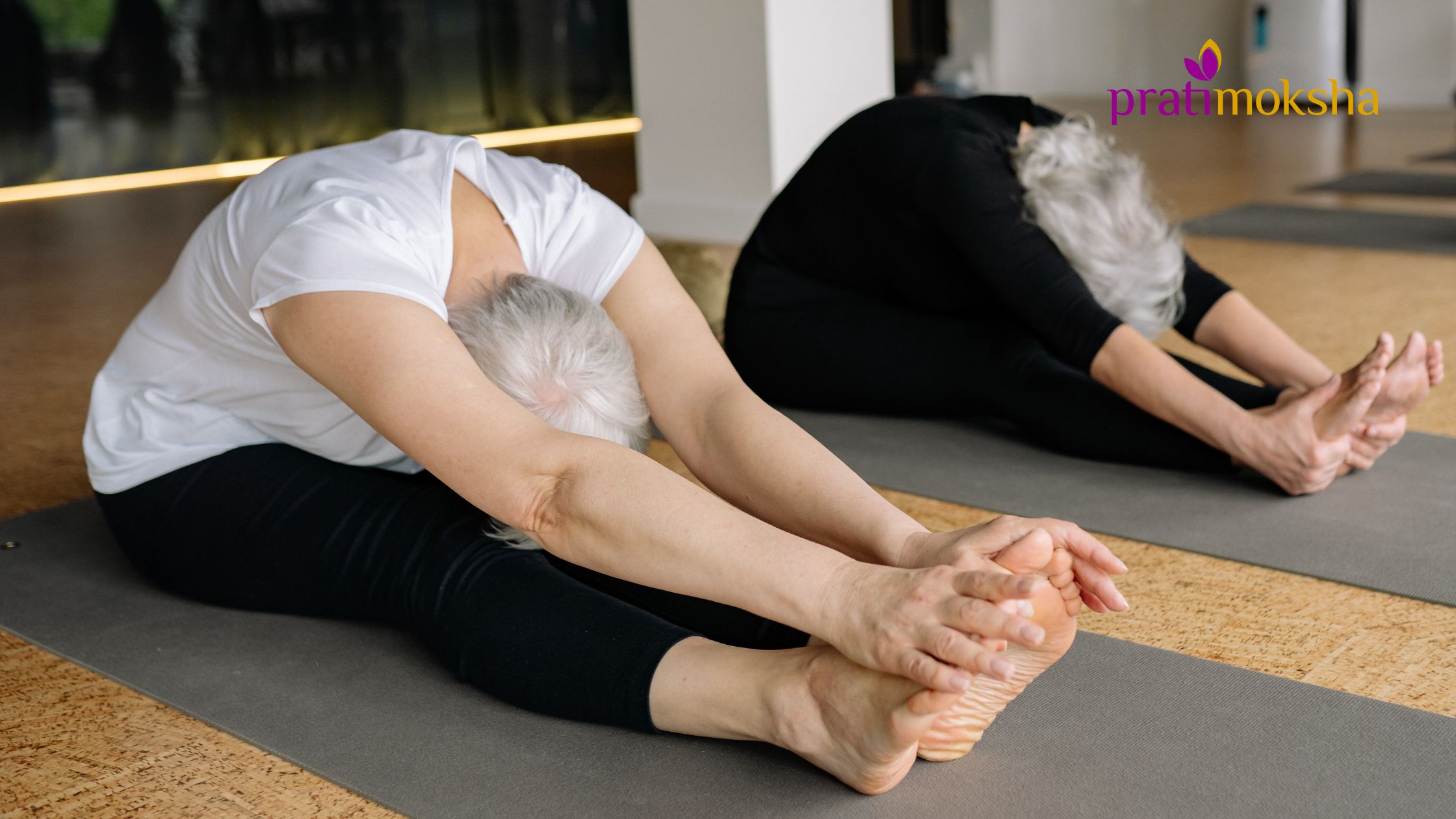
A well-designed yoga programme accommodates all of these people without requiring them to identify themselves as exceptions or request special treatment. The practice is adapted by a skilled instructor as a matter of course. This is one of the principles that runs through everything Lalitha Viswanath has built at Pratimoksha, that yoga should be genuinely accessible to the person in front of the teacher, not to an idealised version of who that person might be.
The yoga therapy approach that informs Pratimoksha’s corporate sessions means that participants with specific health concerns are not left to modify independently. The programme is structured from the outset to include rather than accommodate.
The Cost Comparison Done Honestly
Corporate gym memberships for Dubai-based teams vary in cost depending on the facility and the number of employees covered. For a mid-sized team, annual costs typically run into five or six figures in dirhams, with a significant portion of that investment reaching only the fraction of employees who actively use the benefit.
A corporate yoga programme delivered twice weekly to the same team costs considerably less per engaged participant, particularly when you account for the substantially higher utilisation rates that on-site, during-hours delivery produces.
The financial comparison is not the most important argument for yoga over gym access. But it is a legitimate one, and it deserves to be made clearly rather than left implicit.
Which One Is Right for Your Organisation
The honest answer is that gym access and a structured yoga programme are not mutually exclusive, and for organisations with the appetite for both, there is genuine complementary value.
But if the question is where to direct a constrained wellness budget for the greatest measurable impact across the broadest cross-section of your workforce, the evidence consistently points in one direction.
The corporate yoga programme at Pratimoksha is available for organisations across Dubai, delivered on-site or online, and structured to fit the real constraints of a working week rather than the ideal conditions that most wellness programmes quietly assume.
Start with a trial session for your team. See who shows up, how they respond, and what they say afterwards. That single data point will tell you more than any comparison article can.




0 Comments